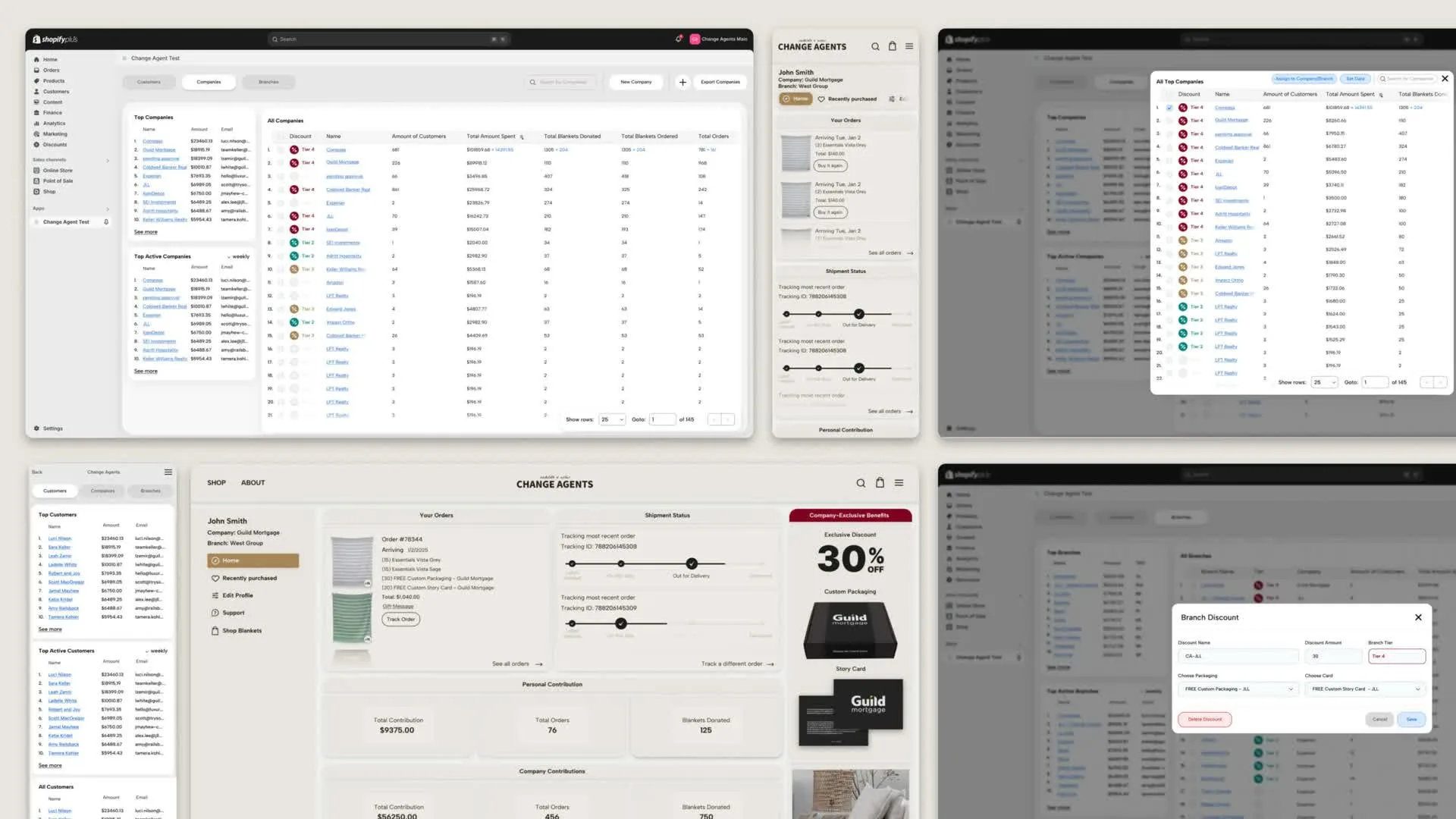
Designing a corporate gifting system that stays operable at scale
Change Agents is a corporate gifting platform built under Sackcloth & Ashes that
combines customer purchasing, tiered benefits, operational tooling, and impact reporting
into a shared system. The platform supports companies ordering at scale while managing
branches, discounts, custom packaging, fulfillment logic, and donation tracking behind
the scenes.
I led UX/UI and front‑end implementation across both the customer‑facing
experience and the embedded admin platform, with a focus on system clarity, operational
reliability, and scalable workflows as program complexity grew.
Role
Lead Product Designer + UI Engineer
Focus
Systems Design · Admin & Operational UX · Front‑End Engineering · Information Architecture · Tiered Program Logic · Cross‑Surface Consistency
↑Designed a multi‑surface commerce and operations platform spanning storefront, customer portal, Shopify Admin, and embedded operational tooling
↑Built systems supporting tiered benefits, branch management, packaging rules, impact reporting, and bulk ordering workflows
↑Store conversion improved from 2.02% to 6.54%. Funnel performance strengthened across end‑to‑end ordering flows
↑Checkout completion rose from 71.0% to 73.2%, with stronger decision‑making signals and reduced friction across the ordering flow
↑Reduced operational overhead through reusable program logic and centralised administrative controls
↑Supported scalable corporate gifting flows while keeping the customer experience simple and understandable
02 — Context
Two surfaces that needed to behave like one system
Change Agents serves two primary audiences: companies purchasing gifts at scale, and
internal teams managing operations, reporting, and program rules. The experience spans
a public storefront, customer portal, Shopify Admin, and a custom embedded admin platform
used to manage companies, branches, tiers, discounts, packaging, and operational controls.
As the program scaled, the challenge shifted.
The work became less about adding features and more about keeping the underlying system
understandable and trustworthy. The operational layer needed to support:
Exceptions and manual overrides without breaking consistency
Synchronisation across storefront, portal, Shopify Admin, and embedded tooling
Reporting and exports for operational decision‑making
Automation of tier progression and benefit application
Evolving business rules without fragmenting the customer experience
Change Agents admin — custom app integration to Shopify
Customer portal
03 — Who We Designed For
Three audiences, one shared system
Change Agents isn't a single product for a single user. Real estate agents,
company administrators, and the S&A operations team all depend on the same
underlying program, but they need completely different things from it.
Designing for one without understanding the others would have broken the system.
Gift Buyer
The Real Estate Agent
Closes deals with blankets. Signs up under a company account to access
corporate pricing and earn benefits as their orders accumulate. They're
not procurement professionals. They want a simple, trustworthy experience
where the discount is clear, the products are right for them, and ordering
takes minutes, not a phone call.
Only see products and pricing relevant to their account, not the full D2C catalog
Clear view of their current tier, discount, and what they've earned
Self-service ordering with full order history: no email, no Excel, no waiting
Account Admin
The Branch or Company Manager
Oversees a group of agents under a company or branch structure. They care
about the program working well for their team: that the discount applies
consistently, that collective spend is being tracked, and that impact
reporting reflects their company's actual contribution. They need visibility,
not manual reconciliation.
Collective spend and impact visible across their company and branches
Confidence that tier benefits are applying correctly for everyone
Branch management without adding operational overhead on their side
Operations
The S&A Operations Team
The internal team that used to process every order manually, receiving
Excel templates, manually fulfilling orders, and reconciling discounts
by hand. Their workload grew with every new company that joined. The admin
platform exists to make their job reliable and predictable instead of
labour-intensive and error-prone.
Reliable admin tooling that replaces manual Excel workflows entirely
Safe override controls for exceptions without breaking downstream consistency
Searchable reporting and exports for operational decision-making
04 — What I Owned
End‑to‑end across both surfaces
01
Customer‑Facing UX/UI
End‑to‑end UX/UI across the storefront and customer portal, including
information architecture, interaction patterns, benefit visibility, and ordering flows.
02
Embedded Admin Platform
UX design and front‑end implementation for the Laravel‑based admin
embedded within Shopify, covering company management, branch relationships, tier
assignment, discounts, exports, and operational controls.
03
Program Logic & System Architecture
System‑level UX for tiered discounts, packaging logic, program benefits,
impact visibility, and the information architecture that kept all surfaces coherent.
04
Operational Tooling
Workflows for company and branch management, discount configuration, overrides,
reporting, exports, and packaging setup, designed for operational predictability
under real‑world pressure.
05
Engineering Collaboration & Front‑End Build
Front‑end implementation across Shopify and the embedded admin, including
shared state logic, synchronisation handling, and ongoing QA across real‑world
operational states and edge cases.
06
Ongoing Refinement & QA
Iterative improvements across asynchronous updates, admin edge cases, and operational
states, keeping the system reliable as program complexity increased.
Unlike standard e‑commerce, Change Agents had to support relationships between companies,
branches, customers, tier benefits, discounts, packaging rules, and impact reporting, all while
keeping the purchasing experience approachable. As operational rules expanded, the risk was system
drift: spreadsheet logic, manual overrides, inconsistent reporting, and fragmented customer
experiences. The platform had to balance four tensions.
Structure vs Simplicity
Company and branch relationships needed to be modelled clearly without exposing operational
complexity to customers placing orders.
Automation vs Control
Benefits and discounts should update automatically while still allowing safe administrative
overrides when business rules required exceptions.
Operations vs Experience
Internal systems needed reporting, exports, configuration, and exception handling while
the storefront stayed calm, familiar, and friction‑free.
Accuracy vs Speed
Tier status, totals, and impact reporting needed to remain trustworthy across asynchronous
updates and multiple surfaces, without slowing down the experience.
The goal was absorbing complexity inside the system rather than exposing it to customers.
06 — Research & Insight
Found by working directly alongside the people affected
Research wasn't a formal process here. It was direct collaboration with
the S&A operations team and Change Agents account contacts, listening
to where the workflow broke down. The clearest signals came from the
manual workarounds: if a team is using spreadsheets to compensate for
missing system behaviour, that's a design problem.
Where Friction Lived
Mixed Product Catalog
Corporate buyers browsing the full D2C site regularly found and selected products outside their program. Every incorrect order required manual correction.
Excel as the Ordering System
Companies submitted orders via emailed Excel templates. As volume grew, so did errors, back-and-forth, and the time cost to S&A operations staff.
Invisible Benefits
Buyers had no way to see their tier status, contribution totals, or earned benefits. Benefits that aren't visible don't change behaviour.
What the Team Said
Manual Work Doesn't Scale
Every new company that joined increased the operations team's manual workload. The process hadn't been designed to grow; it had just grown.
Customers Expected More
Change Agents customers were disappointed by the gap between program promises (benefits, tiers, customisation) and the actual ordering experience they got.
Overrides Had No Structure
Exceptions like custom discounts, branch adjustments, and packaging rules were handled ad hoc. There was no system for them, so each one created unpredictable downstream effects.
Design Principles
Self-Service Over Gatekeeping
If customers can do it themselves reliably, they should. The portal exists to eliminate every unnecessary touchpoint between a buyer and their order.
Exceptions Need Structure Too
Overrides and manual adjustments shouldn't live in email threads. They need designated admin controls that don't break the system when used.
Visibility Drives Behaviour
Tier progress, contribution totals, and earned benefits need to be immediately visible to actually influence purchasing decisions.
Key Insights
01
A shared storefront doesn't work for buyers with different product eligibility
Hypothesis
Corporate buyers could browse the full S&A site and find what they needed without confusion.
Signal
Agents were regularly selecting D2C products they weren't eligible for, generating orders that required manual correction before fulfillment.
Response
Built a dedicated Change Agents portal with a curated product catalog containing only what corporate buyers can actually order, priced correctly for their tier.
When product eligibility isn't enforced by the interface, it falls on the operations team to catch errors after the fact. That's not a QA problem. It's a design problem.
02
Manual workflows have a ceiling that appears without warning
Hypothesis
An Excel template and email submission process would work as long as order volume stayed manageable.
Signal
Every new company that joined the program added proportionally to the S&A team's manual processing workload; errors, corrections, and turnaround time all scaled with it.
Response
Replaced the Excel workflow with a fully self-service ordering portal, so companies could place, track, and manage orders without any S&A involvement in routine transactions.
Manual processes don't break slowly. They hold up and then collapse. The goal was to move the ceiling before it became a problem for customers waiting on their orders.
03
Benefits only change behaviour when buyers can see them clearly
Hypothesis
Offering tier benefits through the program would be enough to drive ordering behaviour and account progression.
Signal
Direct collaboration with Change Agents contacts revealed customers didn't know what tier they were in, what they'd earned, or how close they were to the next threshold.
Response
Built the customer portal dashboard to surface tier status, personal and company contribution totals, and active benefits at a glance, making the program's value visible on every visit.
Invisible benefits are wasted benefits. The portal needed to show people exactly where they stood and what ordering one more time would unlock.
07 — System Architecture
One program expressed across multiple surfaces
Change Agents is not a single interface. It is a shared operational system expressed
across the public storefront, customer portal, Shopify Admin, and a custom embedded
admin platform. Each surface serves a different audience, but all of them depend on
the same underlying program logic staying synchronised and trustworthy. A major
constraint was preserving Shopify's operational reliability while extending it with
branch structures, tier progression, discount systems, packaging configuration, impact
tracking, and operational controls, without creating a disconnected parallel system.
What the system needed to support
Bulk corporate ordering flows with company and branch attribution
Tier progression and discount synchronisation across all surfaces
Packaging and fulfillment configuration tied to company tier and order rules
Impact reporting across customers, orders, branches, and companies
Administrative overrides without breaking system‑wide consistency
Reliable synchronisation between storefront, customer portal, Shopify Admin, and embedded tooling
Core system principles
Shared Program Logic Across All Surfaces
Tier rules, discounts, reporting, and benefits needed to resolve consistently across customer and admin experiences; no surface maintained its own version of the truth.
Operational Tooling Built for Real Usage
Internal teams needed searchable tables, exports, safe editing patterns, overrides, and predictable workflows, not workarounds and spreadsheets.
Automation With Controlled Flexibility
The system automated tier progression and benefit application while still allowing operational exceptions when required, without breaking downstream consistency.
Shopify as the Operational Foundation
The architecture extended Shopify rather than replacing it, preserving operational reliability, existing workflows, and the storefront experience customers already understood.
System Architecture
What this enabled
Customer‑facing simplicity while supporting full operational complexity behind the scenes
Tier benefits applied consistently across orders, reports, and admin views without manual reconciliation
Peak seasonal volume handled without requiring new operational flows each cycle
Safe administrative overrides that didn't break downstream synchronisation
Scalable program growth without fragmenting the experience on either surface
08 — Admin & Operational UX
Internal systems are product surfaces too
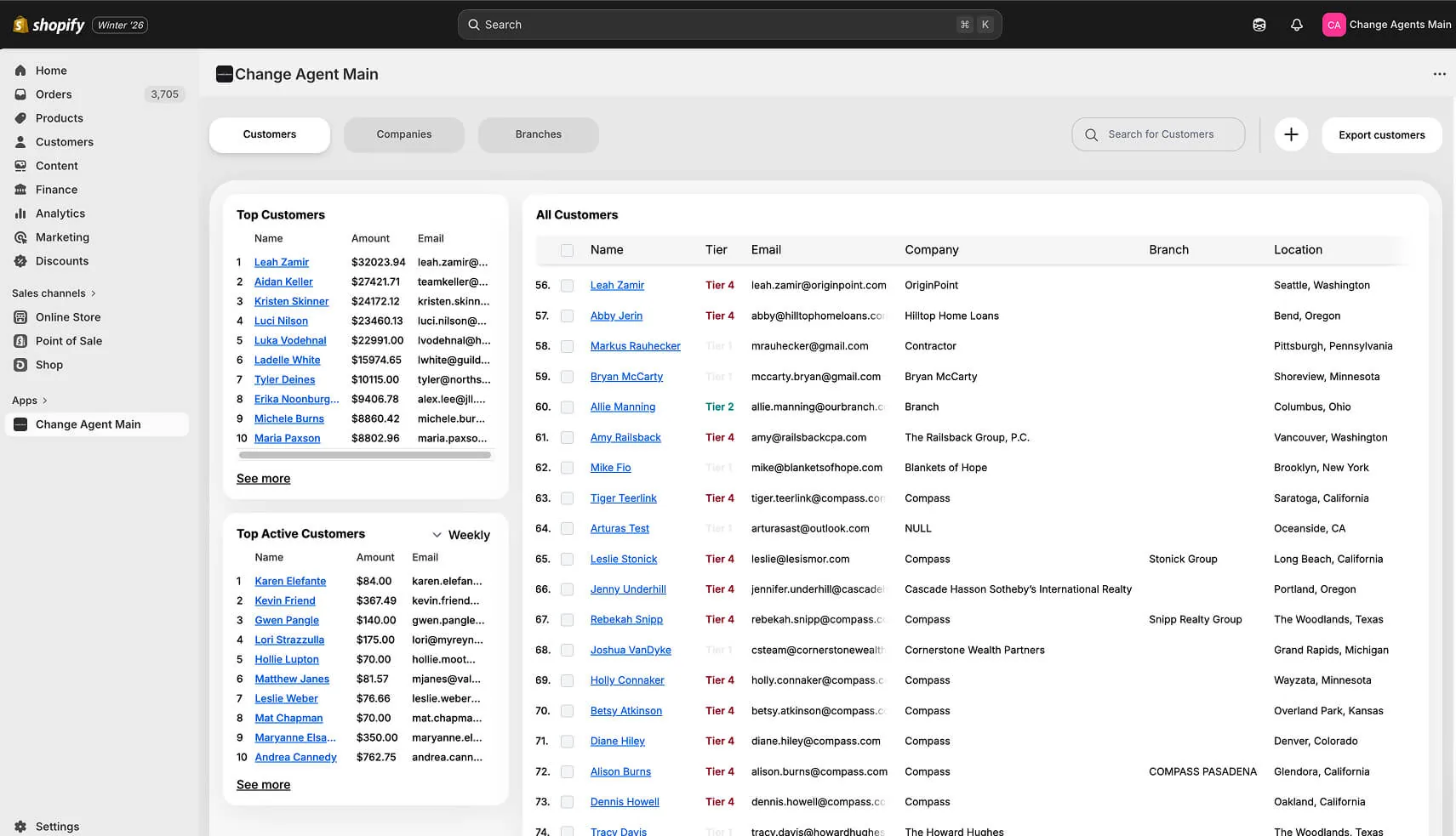
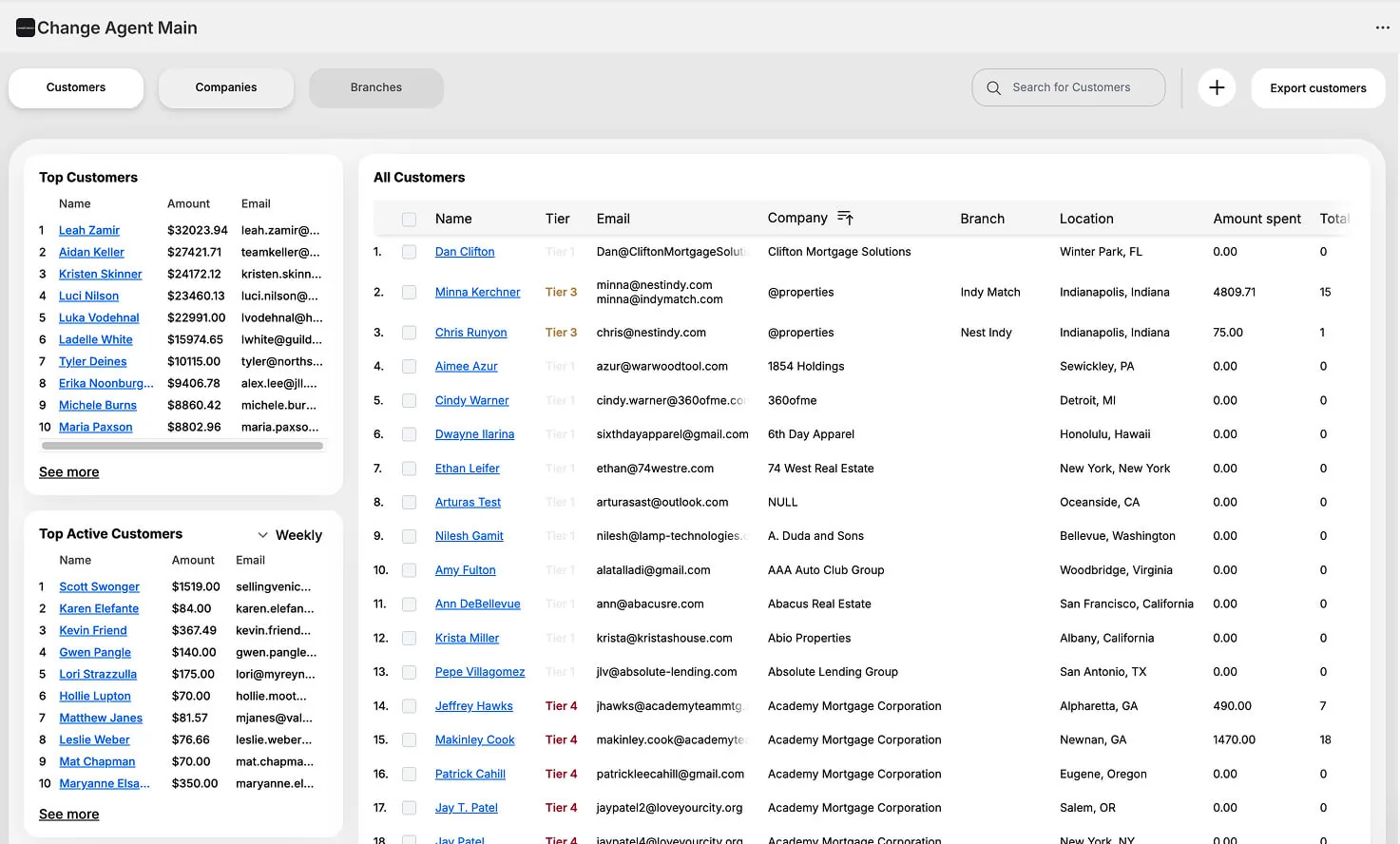
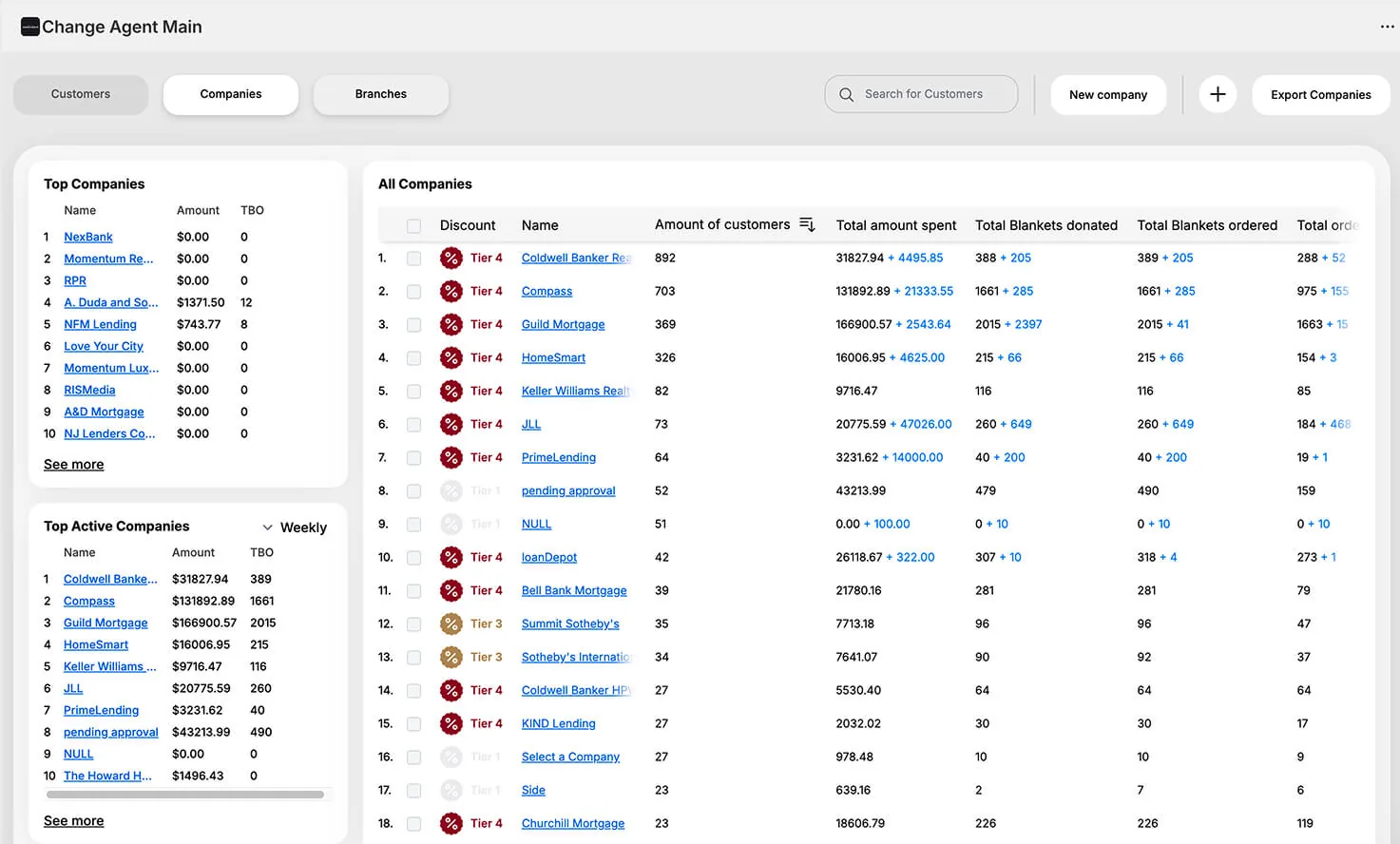
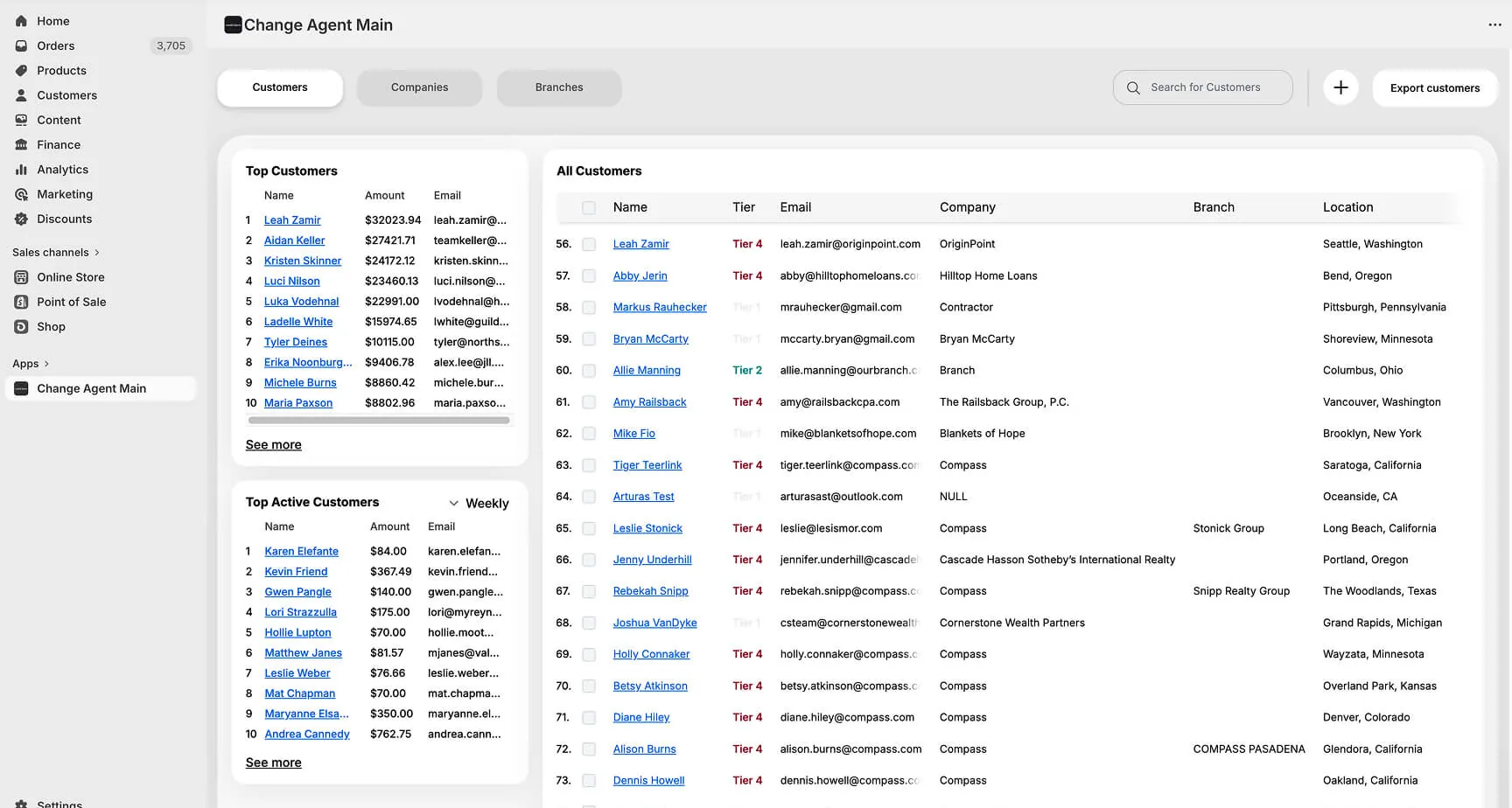
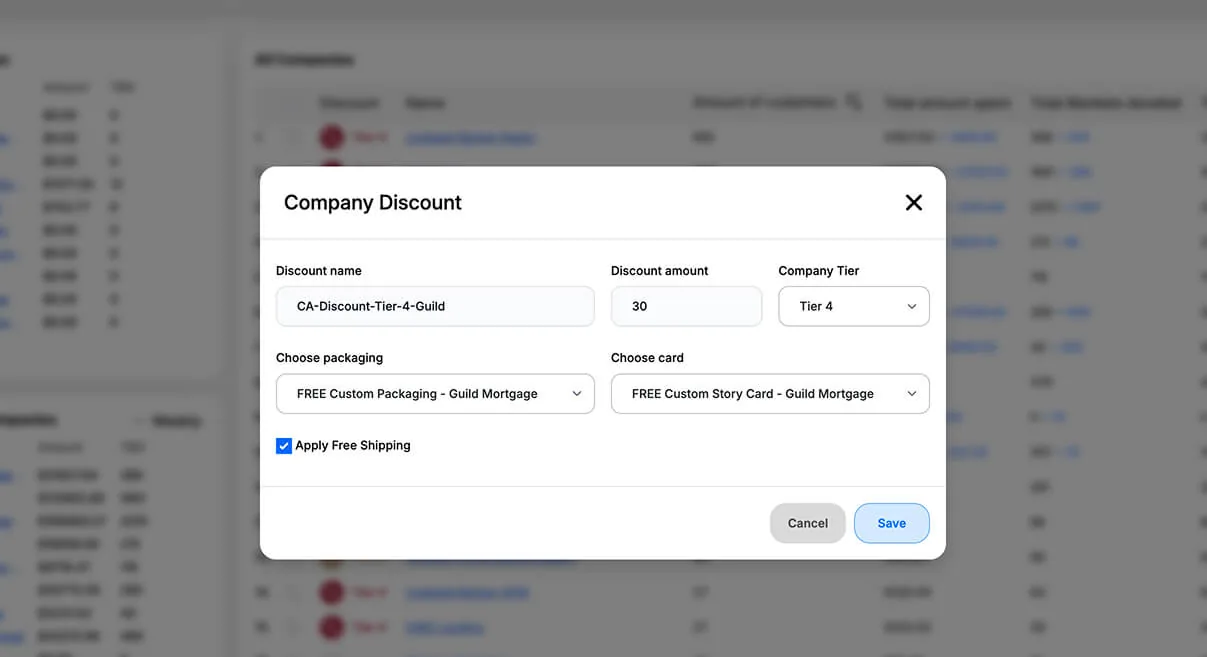
A large portion of the platform's complexity lived inside operational tooling rather than
customer‑facing UI. The embedded admin platform supported company management, branch
relationships, tier assignment, discounts and overrides, reporting workflows, exports, and
packaging configuration.
These systems needed to feel predictable under real operational pressure. That meant
prioritising searchable table structures, safe editing behaviour, visible status systems,
reliable synchronisation states, and low‑risk operational flows so internal teams
could work quickly without introducing errors into the customer experience.
Customer management
Company management
Shopify-embedded view
Tier configuration
09 — Customer Experience
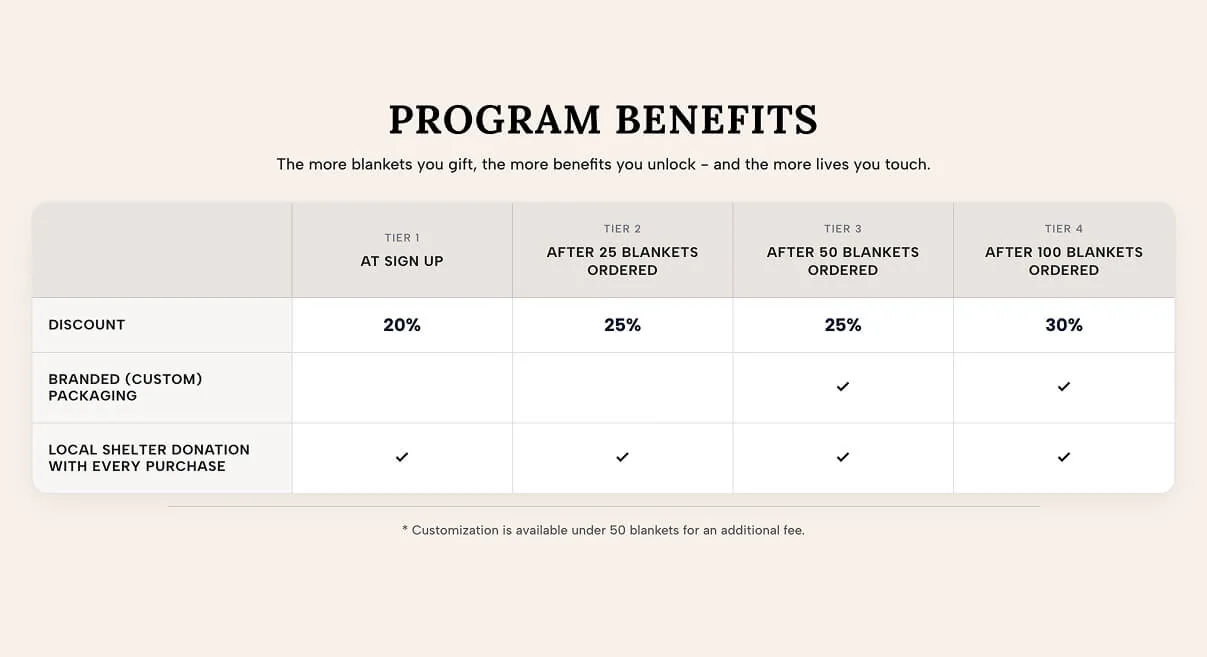
Tier systems only work when customers understand them immediately
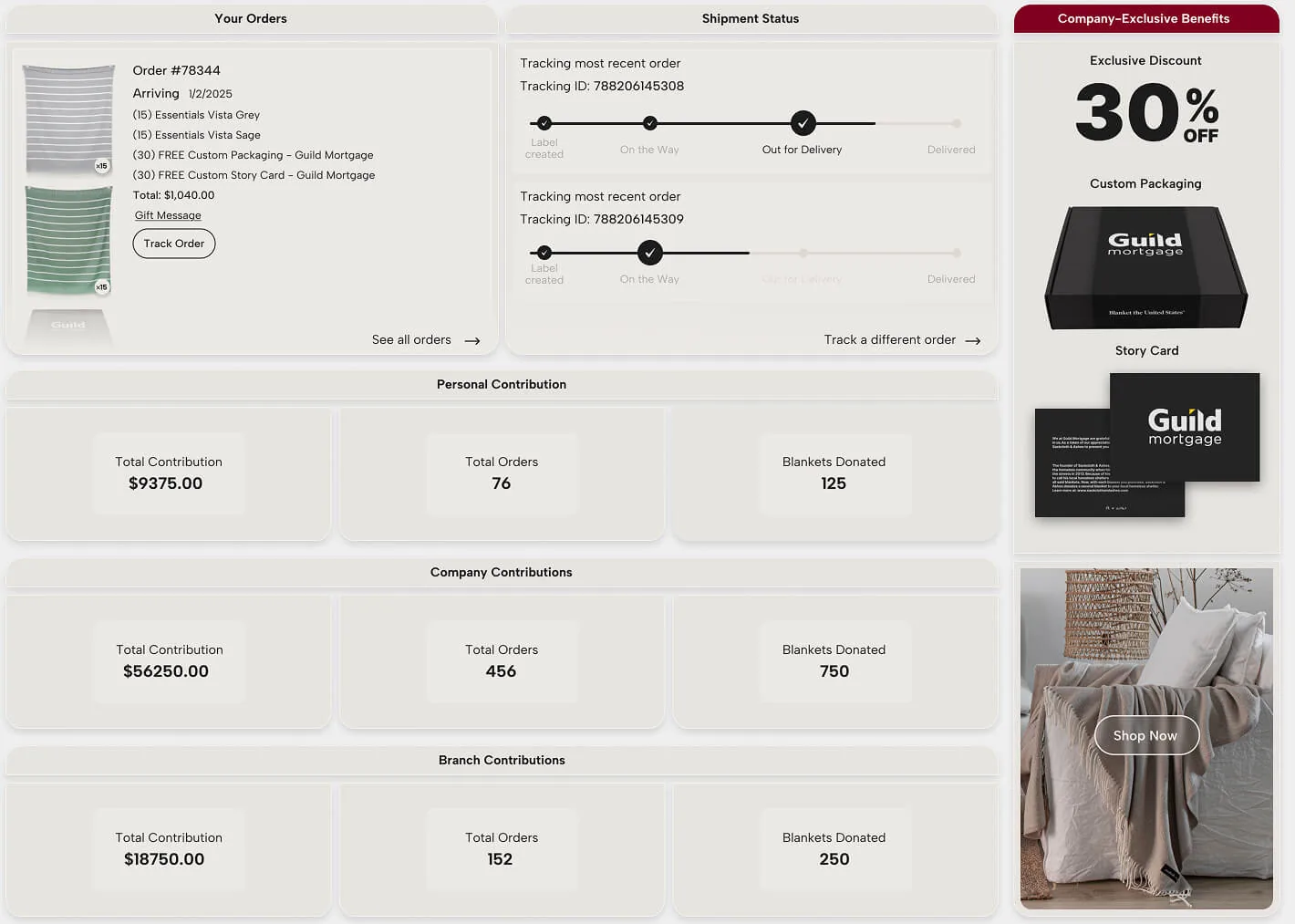
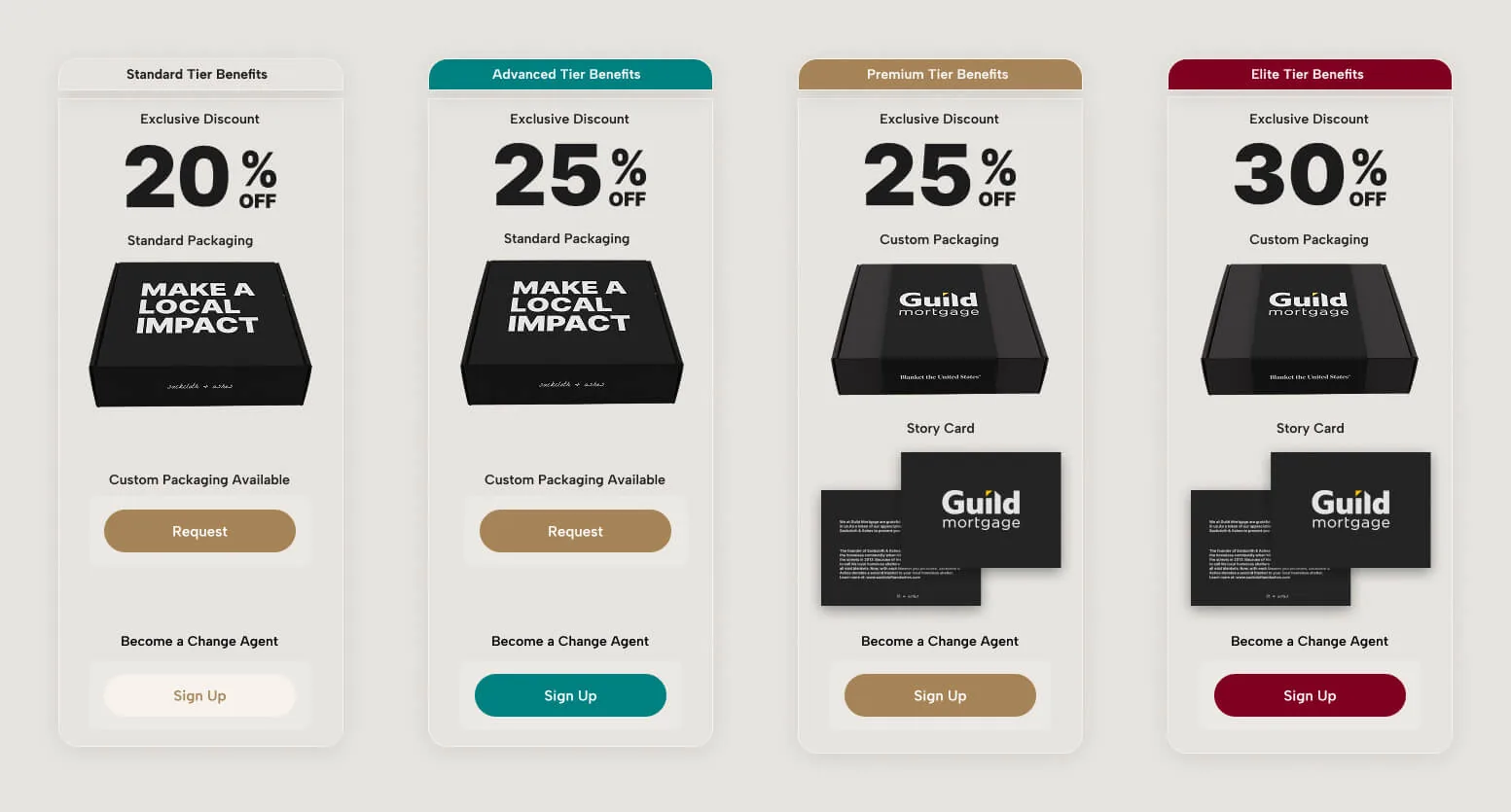
A major surface of the customer experience was making the program's value legible. Customers
needed to immediately understand what benefits they had, why they qualified, and how the
program would behave as their orders accumulated.
The interface focused on visible progression, clear benefit summaries, trustworthy impact
visibility, and low‑friction understanding, without requiring support intervention
or manual explanation. When the program is clear, customers order confidently. When it's
opaque, they hesitate or stop.
Customer portal — orders, contributions, and program benefits
Program benefits — storefront
Tier benefit cards
10 — Engineering Collaboration
Designing systems that remain consistent in production
The platform relied on synchronisation between Shopify, embedded Laravel admin tooling,
APIs, webhooks, reporting systems, and customer‑facing surfaces. I worked closely
with engineering to ensure interaction logic, operational states, and program rules stayed
consistent across the system.
Front‑End Implementation
Built and maintained UI across Shopify (Liquid/HTML/CSS/JS) and the embedded Laravel admin, ensuring interaction patterns stayed consistent across surfaces.
Shared State & Synchronisation
Designed UX flows aware of asynchronous system behaviour, ensuring tier updates, benefit applications, and reporting stayed in sync across the platform.
Operational Edge Cases
Worked through real‑world scenarios: override flows, synchronisation failures, admin exception handling, and bulk ordering edge cases before they reached production.
QA Across Real Workflows
Ongoing QA under real operational conditions: not just happy paths, but exception states, admin overrides, reporting discrepancies, and seasonal volume spikes.
Design decisions were shaped directly by asynchronous system behaviour, operational
reliability, admin workflows, data consistency, implementation feasibility, and
long‑term maintainability. The work became less about individual screens and more
about designing reliable behaviour across connected systems.
11 — Outcomes & Signals
Operational stability with measurable lift
As the system matured, the clearest gains appeared in operational reliability and conversion
consistency during high‑volume corporate gifting periods.
6.54%
Store conversion up from 2.02% in H1. Funnel performance strengthened across end‑to‑end ordering flows.
73.2%
Checkout completion up from 71.0%. Stronger decision‑making signals and reduced friction across the ordering flow.
↑ retention
Returning customers generated the majority of revenue, signalling strong account‑based retention behaviour.
Store conversion increased from 2.02% (H1) to 6.54% (H2)
Checkout completion increased from 71.0% to 73.2%
Funnel performance strengthened across end‑to‑end ordering flows
Returning customers generated the majority of revenue, driving strong account‑based retention
Tier benefits applied consistently across orders and reporting systems
Peak seasonal volume handled without requiring new operational flows
Operational Signal
The strongest outcome was not a single metric. It was that the system stayed coherent
while supporting bulk ordering, branch relationships, reporting complexity, discount
synchronisation, operational overrides, and increasing seasonal demand, without
fragmenting the customer experience.
12 — What We Changed
From spreadsheets and emails to a system that runs itself
The most significant design work here wasn't a screen or a component.
It was replacing an entire manual workflow with one that doesn't need
a person in the middle for routine transactions.
01
The Excel-to-portal transformation
Before the portal existed, placing a corporate order meant browsing
the full S&A website (which included D2C products they couldn't
actually buy), filling out an Excel template, emailing it to the
S&A team, and waiting. Every order required manual processing on
the S&A side: check the template, verify the products, confirm
the discount, fulfill. As more real estate companies joined the program,
this overhead multiplied. It wasn't sustainable. Customers could see the gap between
what the program promised and what the experience delivered.
Order workflow: before and after
Before
Browse full S&A D2C website
Select products — including ineligible D2C items
Download and fill Excel template
Email template to S&A operations
S&A manually validates and corrects
S&A manually fulfills and ships
No order visibility for the customer
After
Log into Change Agents portal New
Browse curated B2B catalog — eligible products only New
Discount applied automatically based on tier New
Place order directly — no email required New
Order processes through Shopify automatically New
Full order history visible in customer dashboard New
Tier progress and impact tracked in real time New
What We Had
Excel template submitted by email, manually processed and fulfilled by S&A for every order
What We Saw
Operations overhead grew with every new company. Customers saw a program that promised benefits and delivered a spreadsheet.
What We Changed
Built a self-service portal with curated products, automatic discount application, direct ordering, and a full dashboard. No S&A involvement in routine transactions.
Result
Customers manage their own accounts. Operations handles exceptions, not every order. The program scales without adding manual overhead.
02
Separating the B2B experience from the D2C catalog
The full Sackcloth & Ashes product catalog was built for individual
consumers: pricing, product mix, copy, and calls to action all assumed
a D2C buyer. When real estate agents browsed that same catalog to place
corporate gifts, they encountered products they couldn't order, prices
that didn't reflect their discount, and no clear distinction between what
was available to them and what wasn't. The fix wasn't a disclaimer. It
was a completely separate, purpose-built product experience.
What We Had
Corporate buyers browsing the full S&A D2C website with no product or price filtering for their account type
What We Saw
Agents selecting ineligible D2C products regularly, creating incorrect orders that had to be caught and corrected manually before fulfillment
What We Changed
Built a dedicated Change Agents storefront with a curated product catalog, correct corporate pricing, and no D2C products that don't apply to their account
Result
Incorrect order rates dropped. Buyers landed on a storefront that made sense for them immediately: no confusion about pricing or eligibility.
13 — Reflection
Systems UX is what keeps complexity usable
Working on Change Agents reinforced how quickly operational complexity surfaces in programs
built around tiers, reporting, and shared account structures. When systems become inconsistent,
teams compensate manually: spreadsheets appear, overrides multiply, reporting drifts, and the
customer experience slowly loses clarity.
What Stayed True
The most valuable work was keeping progression understandable, operational tooling predictable, and program behaviour consistent across surfaces
Internal tooling deserves the same UX rigour as customer‑facing products
Automation works best when paired with safe override systems
Multi‑surface products succeed when behaviour stays consistent across contexts
What I Took Forward
Shared operational logic matters more than isolated interface polish
Absorb complexity structurally instead of manually; systems scale more reliably that way
Operational clarity is a customer experience decision
When the system is consistent, the experience takes care of itself
Experience the Live Platform
See it in context
Explore changeagents.com to see the platform in context, including tiered gifting flows,
customer benefits, and the operational program structure.